
How Much Own Contribution Do You Need to Buy a House in Belgium (2026)?

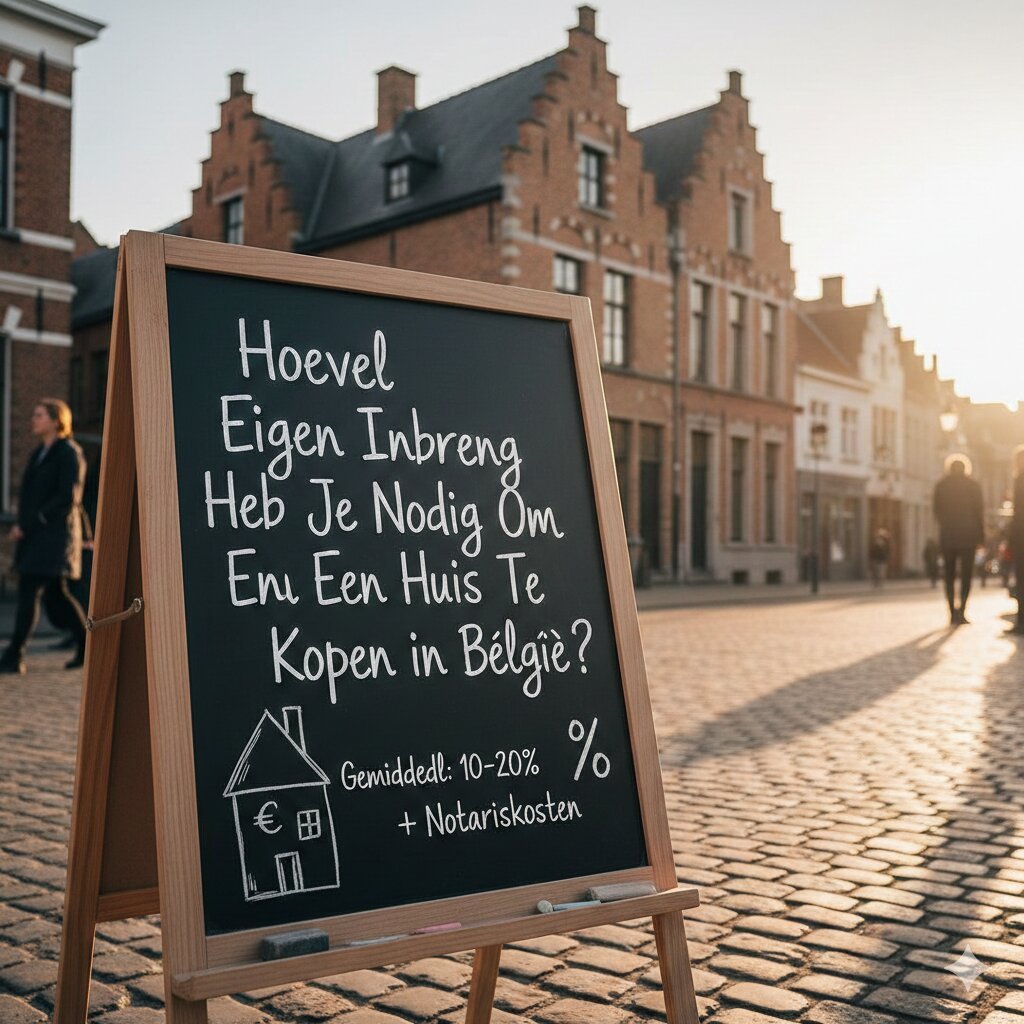
In Belgium, banks in 2026 typically aim for an own contribution of at least 10-20% when purchasing a property.
- Strict minimum rule (in theory): banks are generally only allowed to finance a maximum of 90% of the purchase price of an owner-occupied home → you must pay at least 10% yourself.
- Practical rule of thumb: because you also need to pay notary fees and registration duties (roughly 12-15%), a 20% own contribution is often the most comfortable position in practice.
- Exceptions: 100% financing (without any own contribution) is still possible in exceptional cases (first-time buyers with strong guarantees, via special schemes), but it is no longer the norm.
1. What exactly is an own contribution?
An own contribution is the portion of the purchase price and associated costs that you pay from your own savings (or with help from your parents), before taking out a mortgage loan.
- This means money that does not come from a loan (no additional consumer credit).
- Banks see an own contribution as a buffer and proof of financial health → the larger your contribution, the lower the risk for the bank.
- A higher own contribution often results in a better interest rate and lower monthly repayments.
An own contribution typically comes from:
- Personal savings.
- Gifts or donations from parents.
- Equity from the sale of a previous property.
2. How much own contribution does the bank expect in 2026?
2.1 Official standard: maximum 90% of the purchase price
The National Bank of Belgium has instructed banks to be cautious with high loan-to-value ratios for owner-occupied homes:
- Standard: finance a maximum of 90% of the purchase price → at least 10% own contribution. This 10% is a theoretical minimum threshold: it is the share of the purchase price that you simply cannot borrow in full from a conventional bank.
- Above 90% (up to 100%) is still possible, but only for a limited share of applications and under strict conditions (first-time buyers, strong incomes, additional collateral).
2.2 Practical guideline: 20% own contribution is considered "healthy"
The question of how much own contribution you need is not only about the purchase price, but also about all the additional costs. Because banks generally do not (fully) finance these costs, many banks, estate agents and mortgage advisers recommend 20% own funds:
✦ 100% free & No obligation
Sell your property with the best agent
Compare the top 3 agents in your region for free and save on commission.
Compare agents →- 10% to cover the portion the bank is not permitted to lend.
- A further 10% (or more) to cover buying costs, including:
- Registration duties or VAT.
- Notary fees and deed costs.
- Bank processing and valuation fees.
- Any architect or advisory fees.
In practice, the following benchmarks are commonly used:
| Level of own contribution | Indication | When is it realistic? |
|---|---|---|
| 10% | absolute minimum | strong applications only, costs financed separately |
| 20% | recommended rule of thumb | covers both the unborrowed share and acquisition costs |
Frequently asked questions
How much own contribution do I need to buy a house in Belgium in 2026?
Banks typically require at least 10% of the purchase price as own contribution, since they can only finance up to 90%. In practice, 20% is the recommended amount because it also covers additional buying costs like notary fees and registration duties.
What counts as an own contribution when buying a house?
An own contribution is the portion of the purchase price and associated costs you pay from your own savings, a gift from parents, or equity from a previous property sale. It cannot come from a loan or consumer credit.
Can I buy a house in Belgium without any own savings?
100% financing is still possible in exceptional cases, for example for first-time buyers with strong guarantees or through special schemes, but it is no longer the standard and only applies to a limited share of applications.
Why do banks prefer a higher own contribution?
Banks see a larger own contribution as proof of financial health and a lower risk. A higher own contribution often results in a better interest rate and lower monthly repayments on your mortgage.
Why is 20% recommended instead of just the 10% minimum?
The 10% minimum only covers the share of the purchase price the bank cannot lend. The additional 10% is needed to pay buying costs such as registration duties, notary fees, and bank processing fees, which banks generally do not fully finance.
"Tech entrepreneur and strategist focused on digital transformation in the real estate sector."