
The Association of Co-owners (VME/ACP) in Belgium: the real story on costs, maintenance and your rights
Why the co-owners' association matters when you buy a flat
Buying a flat means buying more than four walls. You automatically become a member of the building's Association of Co-owners (VME/ACP). That association decides on the roof, the lift, the façade, the entrance hall, the garden, major renovations and the shared costs. The way the VME/ACP operates directly determines:
- How high your monthly charges are
- How well - or badly - the building is maintained
- How smoothly decisions on renovations and improvements are made
- What your flat will be worth in 10 or 20 years' time
A well-run VME/ACP is therefore invaluable. A poorly managed one is a red flag for any buyer.
This guide explains clearly how a VME/ACP works in 2025: governing bodies, costs, reserve fund, rights, obligations and pitfalls.
What exactly is a VME/ACP?
A VME/ACP is the legal entity that represents all co-owners of a building. As soon as there are at least two separate owners in a building with both private and common parts, a VME/ACP is automatically created.
Key points:
✦ 100% free & No obligation
Sell your property with the best agent
Compare the top 3 agents in your region for free and save on commission.
Compare agents →- Membership of the VME/ACP is compulsory for every flat owner.
- The VME/ACP manages the common parts: roof, façade, hall, lift, stairwell, pipes, garden, parking…
- The rules are set out in three key documents:
Together, the basic deed and the co-ownership regulations form the statutes of the building.
The three pillars of an apartment building: statutes, VME/ACP and syndic
1. The basic deed and co-ownership regulations
The basic deed describes the entire building: private parts, common parts and each lot's share (quota) in the common parts. That share also determines your voting rights and how costs are divided.
The co-ownership regulations set out:
- The rights and obligations of each co-owner for both private and common parts
- Rules on the allocation of costs
- The operation of the general meeting
- The powers of the syndic (property manager)
Important detail: the statutes must be drawn up in an authentic deed before a notary and published, as must any subsequent amendment.
2. The Association of Co-owners (VME/ACP)
The VME/ACP is the collective body of all co-owners and has legal personality. It decides collectively on:
- Maintenance and renewal of the roof, lift, façade, hall and garden
- The annual budget and financial settlements
- Works to the common parts
- Appointing or dismissing the syndic
- Amendments to the regulations
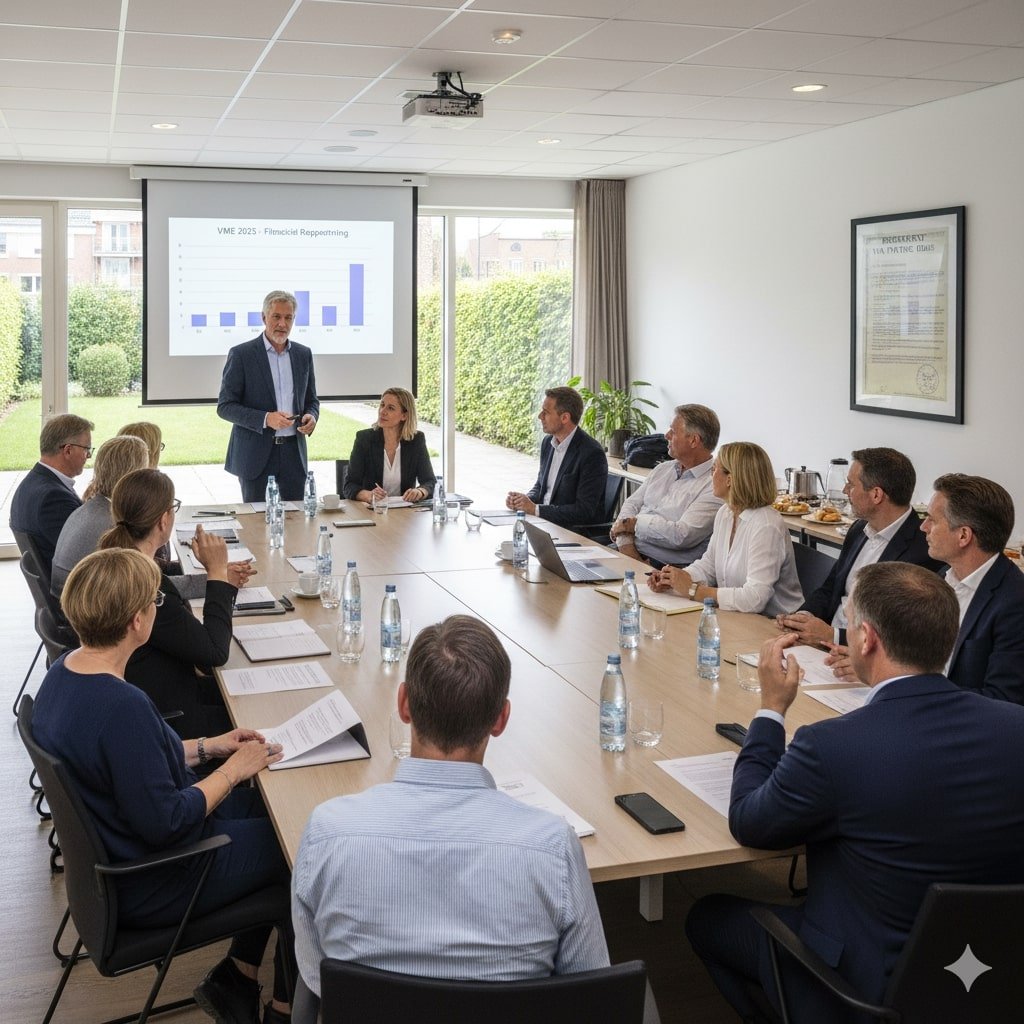
Decisions are made at the general meeting (GM), where your voting rights are proportional to your share (quota) in the VME/ACP.
3. The syndic (compulsory)
Under Belgian apartment law, a syndic is compulsory in every building with multiple owners: this can be a professional syndic or a co-owner acting as a volunteer syndic.
The syndic's responsibilities:
- Implementing decisions of the GM
- Financial management of the working capital and reserve fund
- Drawing up the budget and accounts
- Convening and organising the general meeting
- Day-to-day management (repairs, contracts, block insurance policy)
- Legal representation of the VME/ACP
The syndic bears personal liability, but the VME/ACP as a whole remains responsible for decisions taken.
Working capital and reserve fund: what are you actually paying for?
The VME/ACP has its own assets, split into two mandatory funds:
Working capital
Comparable to a current account:
- Used for recurring expenses: electricity for the common parts, cleaning, lift maintenance, syndic fees, minor repairs
- Funded by advance contributions from co-owners (monthly or quarterly)
- Annual settlement: any surplus is refunded or offset; any deficit is charged on
Reserve fund
Comparable to a savings account:
- For large, exceptional expenditure: a new roof, lift replacement, major façade renovation
- Legally compulsory and subject to a minimum level:
- The amount and allocation key are set by the GM and the statutes.
A healthy reserve fund prevents you from suddenly having to pay thousands of euros extra when major works become necessary.
How are VME/ACP costs divided?
The basic deed sets each lot's quota (share in the VME/ACP). Costs are divided on that basis:
- General costs (insurance, syndic, cleaning, shared lighting) → allocated according to quotas.
- Specific costs (lift, garages, garden) → can be lower or zero for lots that do not use them, following the principle of
Frequently asked questions
What is the VME/ACP and do I have to join it?
The VME/ACP is the legal entity that represents all co-owners of a building. Membership is compulsory for every flat owner - it is created automatically as soon as a building has at least two separate owners with both private and common parts.
What does the reserve fund cover and how much must co-owners contribute?
The reserve fund is used for large, exceptional expenditure such as a new roof, lift replacement or major facade renovation. By law, the annual contribution must be at least 5% of the total expenditure of the previous financial year.
What is the difference between the working capital and the reserve fund?
The working capital acts like a current account and covers recurring expenses such as cleaning, lift maintenance, syndic fees and minor repairs. The reserve fund acts like a savings account and is set aside for major one-off works on the common parts.
Is a syndic mandatory in every Belgian apartment building?
Yes, under Belgian apartment law a syndic is compulsory in every building with multiple owners. This can be either a professional syndic or a co-owner who volunteers for the role.
How are the shared costs divided among co-owners?
Each lot has a quota set out in the basic deed, and general costs such as insurance, cleaning and syndic fees are divided according to those quotas. Specific costs for features like a lift or garden can be lower or zero for owners who do not use them.
"Real estate expert focused on quality control and strategic partnerships."