
Why Houses Are Expensive in Belgium: 8 Economic Reasons

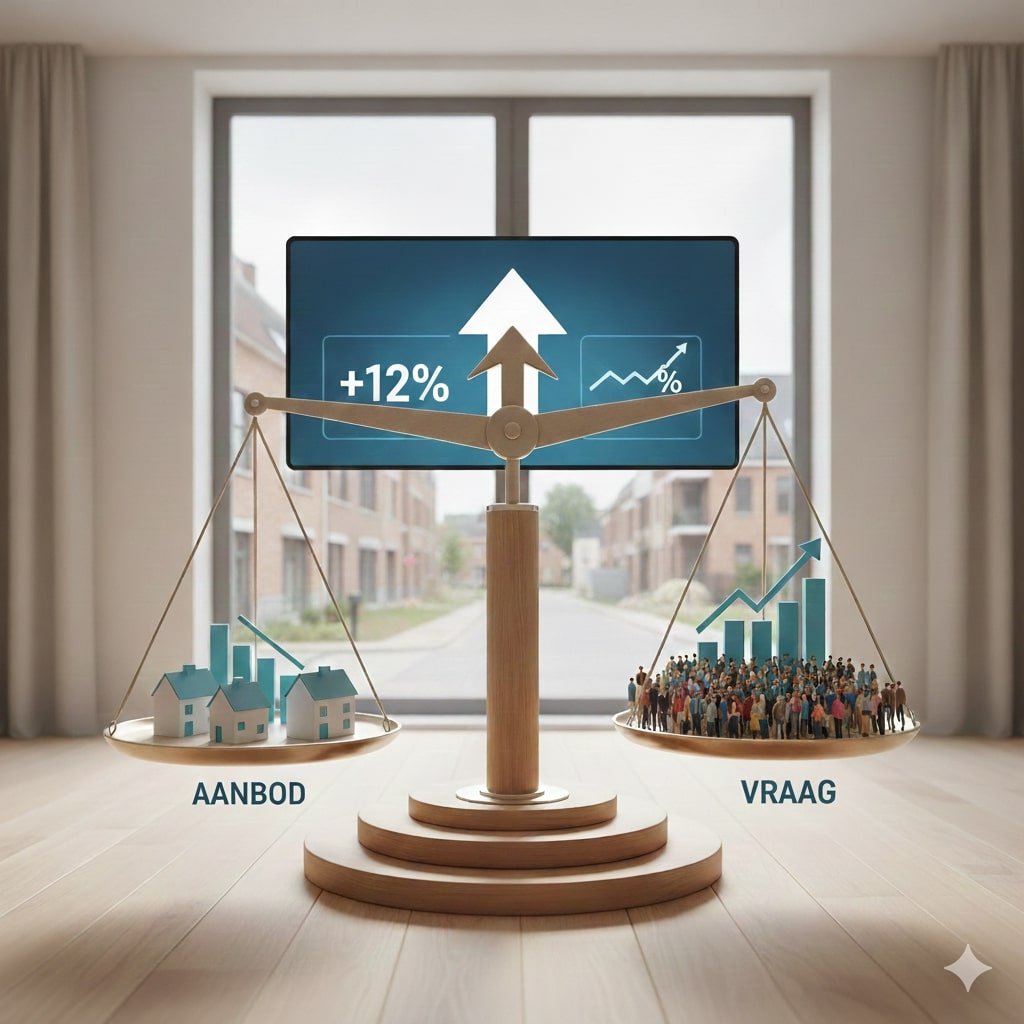
Why houses are expensive in Belgium A question on everyone's lips: why have homes in Belgium become so unaffordable? Ten years ago you could buy a reasonably decent house for €200,000. Today you easily pay €350,000 for the same property. This is no coincidence - there are concrete economic reasons behind this explosion in house prices. In this analysis we explain why houses are so expensive.
1. Housing scarcity (supply < demand)
The biggest reason: there are simply too few homes for too many buyers.
The causes:
- Belgian municipalities are not building enough new housing
- Much land is reserved for other purposes (industry, agriculture, public land)
- Spatial planning rules are strict - you cannot build just anywhere
- Construction procedures take a long time (permits, bureaucracy)
The consequence:
More buyers than available homes = prices go up. This is basic economics: demand higher than supply = price rises.
The numbers:
In Brussels and across Belgium, the housing shortage is chronic. For every property sold, there are at least 2 to 3 potential buyers interested. This pushes prices up sharply.
✦ 100% free & No obligation
Sell your property with the best agent
Compare the top 3 agents in your region for free and save on commission.
Compare agents →2. Low interest rates (until 2022)
For the past 15 years, interest rates were historically low. This was a golden era for buying - but it drove prices up considerably.
How it worked:
- Low rates (0.5% to 1.5%) meant low monthly repayments
- If you borrow €300,000 at 3% interest: you pay roughly €1,300/month
- The same loan at 5% interest: you pay roughly €1,600/month
The consequence:
With low rates, more people could get a mortgage, so demand for homes increased. And more demand = higher prices.
Recent shift:
In 2022-2023, rates rose sharply (3% → 5%). This should have pushed prices down. But the opposite happened - many properties were sold quickly before rates climbed even higher. This triggered a last-minute rush, which actually drove prices up further.
3. Inflation and rising costs
Everything has become more expensive - including homes.
What is rising:
- Building materials: timber, steel, cement, insulation - all at least 20-30% more expensive since 2020
- Labour: construction workers demand higher wages (understandably, given inflation)
- Energy: this affects renovation work and the transport of materials
- Land prices: because land is scarce, its price is rising too
Example:
A house that cost €300,000 to build in 2019 now costs €380,000+ for the same quality.
Consequence:
Sellers ask for more because their costs were higher. This puts upward pressure on the entire market.
4. Investors and speculators
Many wealthy foreigners, companies and private investors buy properties not to live in - but to make money.
What happens:
- Investors buy properties speculatively
- They renovate them cheaply and sell them at a high price
- Or they rent them out at high rents
- This draws large amounts of capital into property
The problem:
This capital squeezes ordinary buyers out of the market. Investors can bid more because they do not need to live in the property - they see it as an investment. This drives up prices for everyone.
The numbers:
In Brussels, approximately 30-40% of all housing is owned by investors or companies - not by families who actually live there.
5. Registration duties and transaction costs (passed on by sellers)
Sellers face significant costs when selling. They pass these on in the asking price.
Costs involved:
- Registration duties (paid by the buyer - 12.5% in Wallonia and Brussels, with possible reductions under certain conditions): roughly €30,000-€50,000 on a €400,000 home
- Estate agent commission (3-4%): roughly €12,000-€16,000
- Notary fees: roughly €3,000-€5,000
Total: roughly €45,000-€70,000 on the sale of a €400,000 home!
Consequence:
Sellers increase their asking price to recoup these costs. This weighs on the entire market. A house that is
Frequently asked questions
Why are house prices in Belgium so high?
There are multiple economic factors driving up prices, including a shortage of available homes, years of low interest rates, rising construction costs, and investors buying properties for profit rather than to live in. For every property sold, there are at least 2 to 3 potential buyers interested, which pushes prices up sharply.
How did low interest rates affect house prices in Belgium?
Low interest rates between roughly 0.5% and 1.5% made mortgages more affordable, which increased the number of buyers in the market. More demand with limited supply drove prices up considerably over the past 15 years.
What share of housing in Brussels is owned by investors rather than residents?
Approximately 30-40% of all housing in Brussels is owned by investors or companies, not by families who actually live there. This reduces the supply available to ordinary buyers and drives up prices for everyone.
How much have construction costs increased since 2020?
Building materials such as timber, steel, cement, and insulation have become at least 20-30% more expensive since 2020. A house that cost 300,000 euros to build in 2019 now costs over 380,000 euros for the same quality.
Do transaction costs influence the asking price of a home in Belgium?
Yes, sellers often increase their asking price to offset costs such as estate agent commissions of 3-4%, notary fees, and registration duties paid by the buyer. On a 400,000 euro home, these combined costs can total roughly 45,000 to 70,000 euros.
"Tech entrepreneur and strategist focused on digital transformation in the real estate sector."